
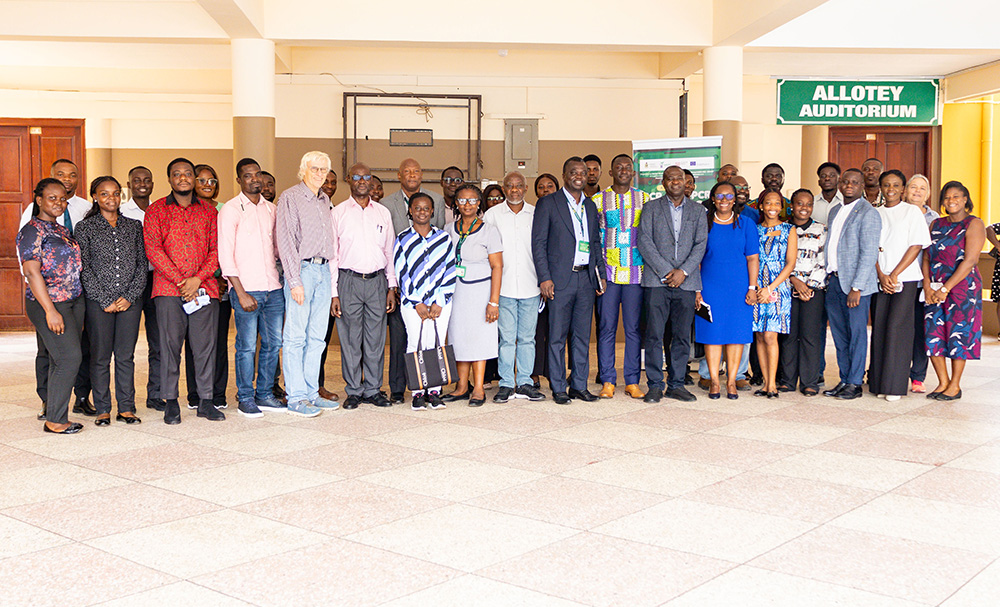
The Vector-Borne Infectious Disease Research Group (VBID-RG) at Kwame Nkrumah University of Science and Technology, Kumasi (KNUST) has organised a three-day Polymerase Chain Reaction (PCR) and Reverse Transcription PCR (RT-PCR) workshop aimed at equipping students with hands-on training in molecular diagnostic techniques.
The workshop brought together students from bioscience background to strengthen their practical skills in infectious disease diagnostics and molecular biology. The initiative forms part of a long-standing collaboration between KNUST and the University of Bremen in Germany.

Professor John Asiedu Larbi, Dean of the Faculty of Biosciences at KNUST, underscored the institutional support behind the initiative.
He noted that the collaboration initiated by Professor Kingsley Badu has the support of the College, the Faculty, and the Central Laboratory.
“It just demonstrates our willingness to join together to ensure that as a Faculty and as a College, we are able to get our students well trained with a lot of practical experience in their fields of endeavour.”
Professor Larbi emphasised the transformative power of PCR technology in scientific research.
“PCR as a test is not only a tool; it is one that transforms research in bioscience areas, both plant and animal sciences,” he explained.
He further highlighted that organising training programmes of this nature helps groom students incrementally, building a cohort of individuals with expertise who can, in turn, train others.

Professor Soerge Kelm, representative from the University of Bremen, highlighted the broader significance of the partnership beyond technical training.
“One of the key things is that this partnership brings Ghana and Africa to Germany,” he stated.
He described the diversity within the collaboration as particularly enriching, noting participation from students across Anglophone countries such as Ghana, Nigeria and Tanzania, as well as Francophone countries including Cameroon and Chad.
“KNUST students have consistently demonstrated excellence and have been exceptionally well prepared. It is evident that KNUST upholds a strong and longstanding tradition of high-quality education and we are privileged for such partnership,” he remarked.

Professor Kingsley Badu, Principal Investigator and Lead of the Vector-Borne Infectious Disease Research Group, traced the roots of the partnership to a decade-long research collaboration between KNUST and the University of Bremen.
He stated that through the African-German Research Collaboration in Infectious Disease, supported by the German government, students from KNUST were given opportunities to travel to Germany to acquire advanced laboratory techniques.
He noted that although sending one or two students to learn the techniques was beneficial, it was not sufficient, this births the need to accelerate capacity development for the country.
Professor Badu explained that the primary aim of the initiative is to develop capacity in infectious disease diagnostics and molecular biology.
“We secured an Erasmus+ Mobility Grant, which enabled experts from Bremen to support this PCR and RT-PCR workshop and other training activities here in Ghana,” he said.
By: Michael Kwawu


